Guides

Peter Justin Yu
Feb 3, 2026
As we end January 2026, the retail landscape requires a higher level of precision than ever before. The "old routes" that relied on pure top-line growth at any cost are no longer sufficient to reach the summit, and brands are now adjusting their strategies to prioritise stability. At ProfitPeak, we are tracking the pulse of our customer base to help you navigate the shifting terrain and stay in sync with the market.
Here is the rolling pulse of trends we are seeing as retailers prepare for the climb ahead:
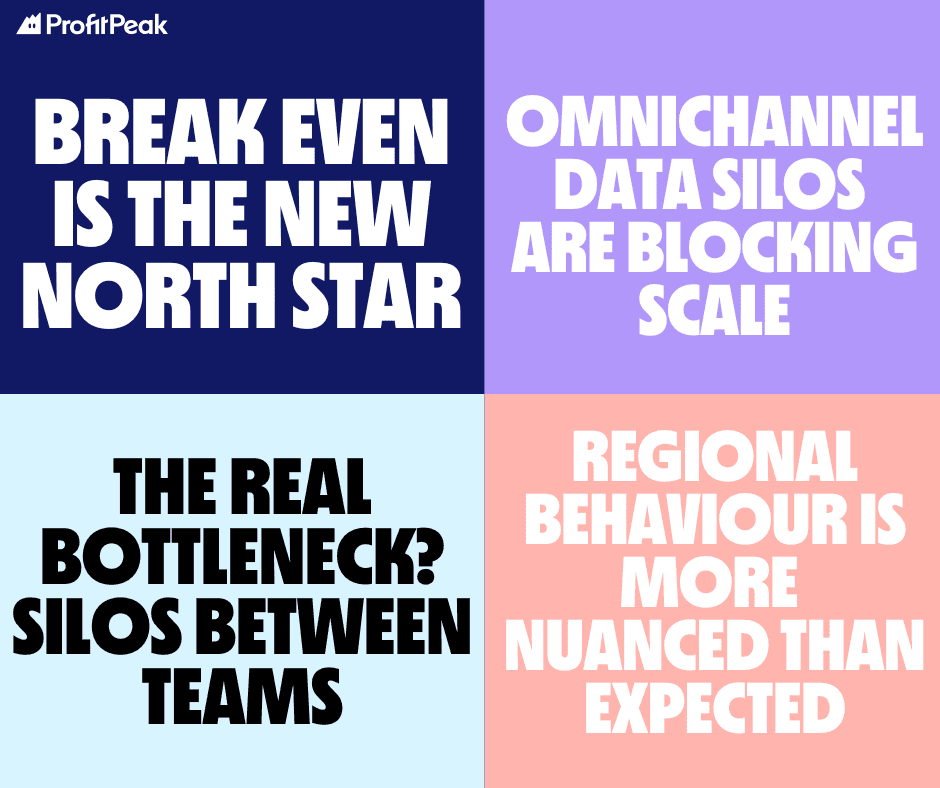
1. Break-even Is The New North Star
We are witnessing a rapid shift from ROAS targets to profit-first decisions faster than expected. Finance teams are moving away from vanity metrics and instead asking the fundamental question: are we actually profitable?
In the current climate, chasing revenue without a granular focus on margin is a significant risk. One industry leader noted that vanity metrics are officially out, and profit-first is in. Profitability is now the primary compass for every strategic move, ensuring that every dollar spent on acquisition is returning real value to the bottom line.
Omnichannel Data Silos Are Blocking Scale
Many brands are still struggling with data silos where wholesale, retail, and online operations exist in separate universes. These gaps prevent leaders from making confident decisions because they are only seeing half the picture.
The brands breaking through in 2026 are those connecting every channel into a single, unified view. By merging these streams, they finally understand true product performance across all touchpoints. Without this visibility, you risk overstocking in one channel while losing sales in another, creating a drag on your overall momentum.
ALSO READ: 13 Bold Predictions for Retail in 2026
Regional Behaviour Is More Nuanced Than Expected
Geo-segmentation is revealing purchase patterns that are more nuanced than many brands expected. What sells in one postcode often fails to work in another.
Brands that lean into regional targeting are finding untapped opportunities in markets they previously wrote off as "too small". By treating your geography as a diverse landscape rather than a flat plain, you can allocate marketing spend with much higher efficiency. This level of detail is essential for navigating modern retail terrain where generic, national campaigns are losing their effectiveness.
The Real Bottlenecks? Silos Between Teams
The most significant bottleneck often isn't the market itself, but the silos between production, marketing, and operations. While these teams often have the data they need, they are frequently not looking at the same map.
When teams access shared data, they move in sync and make decisions significantly faster. One founder highlighted that merging production and marketing data is particularly helpful for staying in touch with what is being pushed versus what is actually being restocked or falling out of stock. This alignment ensures the entire team is roped together, moving toward the same goal without internal friction.
Navigating the Route Ahead
Staying aware of these shifts allows you to adjust your path and prepare for the challenges of 2026. This year is about ensuring your team is aligned with a single source of truth to maintain peak performance. By focusing on profit-first clarity and removing departmental silos, your brand can navigate the steep sections of the market with confidence.
Peter Justin Yu
Founding Marketer
Peter is a veteran marketer with more than 15 years in tech - securing three successful startup exits by amplifying game-changing businesses across APAC through digital storytelling.