Co-founder Insights

Carla Penn-Kahn
Jan 29, 2026
For years, the DTC playbook was simple: grow fast, raise often, and assume an exit would take care of itself.
But the market has changed.
Today, the “art of an exit” isn’t just about building a brand people love. It’s about building a business that investors will pay a premium for. And that comes down to one thing many brands still underweight:
Profit.
Because without profit, your valuation often collapses into something far less exciting.
In many cases, without profitability, brands aren’t valued on revenue at all. They’re valued on stock on hand at best.
The Exit Equation Has Changed
If you’re a DTC founder thinking about an exit, whether that’s an acquisition, a strategic sale, private equity, or even an IPO, you need to understand the new reality:
Revenue alone isn’t enough.
The best outcomes come when product, marketing and margin move in sync, because that’s what creates operating leverage. Operating leverage is what creates real valuation.
What happens when they don’t move in sync?
If you scale marketing without scaling product, you burn cash on demand you can’t fulfil, waste ad spend, and risk customer experience.
If you scale product without scaling marketing, your cash conversion cycle slows, inventory piles up, and you’re forced to discount. That hurts margin and trains customers to wait for sales.
If you scale both without protecting margin, you may look bigger, but you’re not worth more.
Growth can be bought. Profit has to be earned.
Why Profit Creates a Blended Valuation
The strongest DTC exits increasingly come from a blended valuation story. One based on both:
Revenue scale and growth
Profitability and cash discipline
Buyers and investors are asking a more sophisticated question now:
“Is this growth repeatable, and does it come with operating leverage?”
If the answer is yes, the valuation discussion opens up.
If the answer is no, you’re not negotiating revenue multiples. You’re negotiating working capital.
And that’s how brands end up valued like inventory businesses rather than scalable consumer brands.
Koala® Is a Perfect Example of the Shift
Koala® is reportedly back on the IPO trail, and this time the numbers look meaningfully stronger.
With investor meetings reportedly underway for a potential $400m float (according to the AFR), this feels less like a “growth at all costs” story and more like a profitability-underpinned consumer brand listing.
And that distinction matters.
Because in consumer and eCommerce IPOs, the conversation typically centres on three things:
Revenue scale and growth (is it still compounding?)
Margin structure (can it hold as the company grows?)
Profitability and cash discipline (is growth being bought or earned?)
Koala®’s latest reported FY25 results give it a far more credible foundation on that third point:
Revenue: $276m
Gross margin: 62%
EBITDA: $13.5m (nearly 3x YoY)
That’s the kind of mix that supports a valuation discussion based on both revenue and profit multiples, rather than just topline momentum.
What Profitability Signals to Investors
In today’s IPO market, investors aren’t just paying for growth. They’re paying for repeatable growth with operating leverage.
A business that can demonstrate strong gross margin, improving contribution margin and growing EBITDA has far more room to defend valuation, especially if broader market sentiment shifts.
Revenue can be inflated by discounting and short-term tactics. Profit is harder to fake.
The Profit Trap Most DTC Brands Fall Into
Many DTC brands can tell you their best-selling products. Far fewer can answer:
Which products are actually driving profit, not just revenue?
Which SKUs scale efficiently and which are eating margin?
Where is cash tied up in slow-moving stock?
What happens to profit if we increase spend next month?
Which creatives and audiences drive profitable demand, not just traffic?
These blind spots are where brands quietly lose exit potential.
Because value isn’t created by being busy. It’s created by being efficient.
ALSO READ: The Future of AI and Shopify: The Transaction Layer Is the New Battleground
What It Really Takes to Build an Exit-Ready DTC Brand
If you want to craft an exit, your focus for the next 12 months should be simple:
Make product, marketing and margin move together every week.
That means building the ability to make decisions across advertising performance, marketing contribution, revenue by product, inventory, margin and forecasting. Not in separate spreadsheets, and not in separate meetings.
Together.
Because when teams have shared visibility, you get fewer cash flow surprises, faster decision-making, better stock outcomes, stronger marketing efficiency and higher profitability.
And ultimately, you get a stronger valuation story.
How ProfitPeak Helps Founders Get Exit-Ready
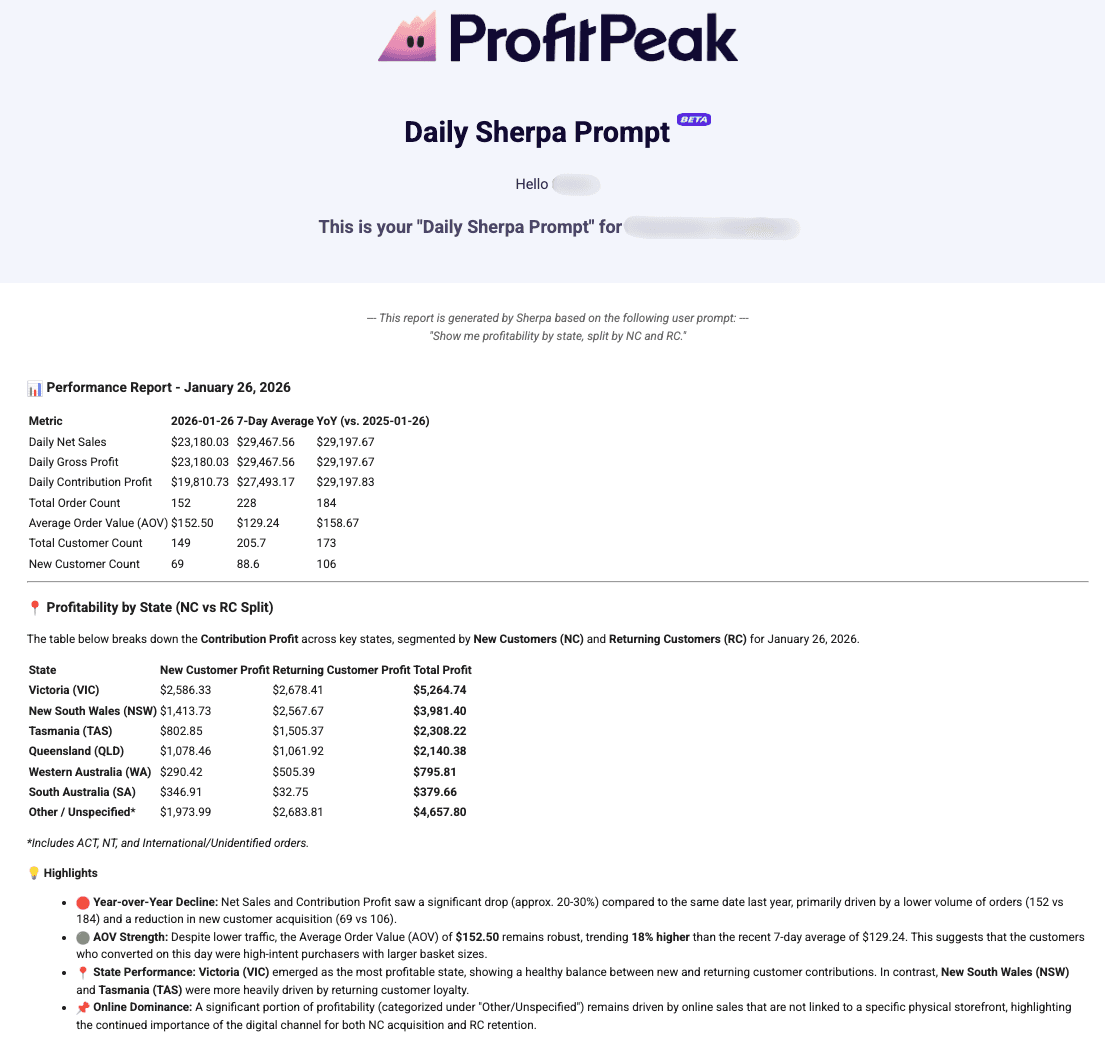
At ProfitPeak, we built Sherpa to help founders and operators run the business with the level of visibility investors expect.
Sherpa is our agentic AI that sits on top of a unified commerce data platform. It connects:
Advertising platforms and paid performance
Marketing channels
Revenue and product performance
Inventory and incoming stock
Margin and contribution profit
Forecasting and demand signals
This means founders can ask questions like:
“Which products are driving profit and should be scaled next?”
“Where are we at risk of stockouts, and what should we reorder?”
“When stock lands, which audiences, creatives and ads should we relaunch first?”
“What’s our cash impact if we increase spend by 20% next month?”
“What is our true contribution margin by product range?”
When you’re preparing for an exit, this is the kind of analysis that sits at the centre of diligence.
Instead of pulling reports across five tools, reconciling spreadsheets and debating whose numbers are correct, much of the operational and performance due diligence can be answered directly inside ProfitPeak using Sherpa.
It’s not just faster. It’s cleaner, more defensible, and easier to explain to investors.
The Bottom Line
If Koala® does come to market, the debate will likely focus on how durable those margins are as it scales internationally, and whether the next leg of growth can be delivered without sacrificing profitability.
Because that’s the question every investor asks now:
“Can you grow without breaking the business?”
The brands that can answer that convincingly don’t just grow faster. They exit better.
And in this market, profit is what turns a revenue story into a real outcome.
Carla Penn-Kahn
CEO & Co-Founder
Carla spent over a decade building and successfully exiting several e-commerce brands, following an earlier career in corporate advisory and investment at Credit Suisse.