Co-founder Insights

David Kahn
Jan 19, 2026
The shift in consumer behaviour towards AI-influenced shopping is no longer a distant theoretical possibility. The signs are beginning to emerge in real time, and they point towards a fundamental change in how people discover and purchase products online.
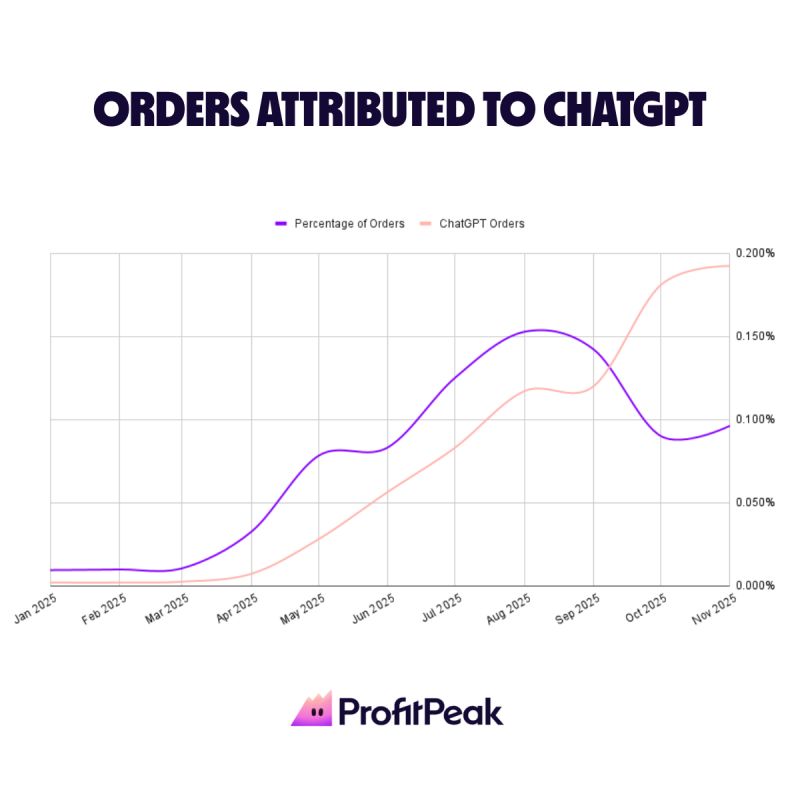
Recent data from ProfitPeak provides a fascinating glimpse into this transition, specifically regarding the volume of orders attributed to ChatGPT. While these numbers remain a tiny fraction of total sales when compared to traditional channels like search or social media, the trajectory is what demands attention. The data suggests that ChatGPT-attributed orders are increasing at an exponential rate month on month, marking the early stages of a new frontier in e-commerce.
A closer look at the accompanying graph reveals a curious trend during the latter part of the year. From January 2025 through to March 2025, the volume of ChatGPT orders was virtually stagnant, sitting near the 0.000% mark. However, a significant breakout occurred in April, kickstarting a steady climb.
While the raw volume of ChatGPT orders continues its upward climb, peaking near the end of the year, the actual percentage of total orders attributed to the AI has seen a notable fluctuation. After rising to a peak of approximately 0.150% in August 2025, the percentage of orders saw a sharp decline through September and October, falling back towards the 0.080% range.
This dip is likely explained by the sheer scale of the peak Q4 sales period. During this time, brands significantly ramp up their traditional advertising spend to drive massive purchase volumes for Black Friday and Christmas. In such a high-volume environment, even a growing channel like AI can see its relative share dip temporarily as the total pool of orders expands rapidly through paid search and social ads.
Interestingly, even as the percentage share dipped, the absolute number of ChatGPT orders continued to soar, nearing the 0.200% threshold by November 2025. This divergence suggests that while AI is growing, it is currently being outpaced by the massive seasonal scaling of traditional marketing.
ALSO READ: Sherpa AI Upgrade: How Smart Inventory Management Fuels Profitability
However, this temporary dip in percentage share should not be mistaken for a lack of momentum. On the contrary, the underlying growth of AI-driven commerce is set to accelerate. A major catalyst for this will be the recent announcement from Shopify regarding store-linked advertising within ChatGPT recommendations.
By bridging the gap between an AI conversation and a direct store checkout, the friction in the buying journey is being systematically removed. We are moving towards a world where a user can ask for a recommendation and complete a purchase without ever needing to perform a traditional manual search.
For e-commerce store owners observing these trends, the primary takeaway is one of measured preparation rather than immediate panic. It is important to remember that ChatGPT-attributed orders still represent a very small percentage of overall sales, evidenced by the fact that the entire y-axis of the data remains below one quarter of one percent. There is still ample time to adjust strategies and prepare for this shift.
That said, it is certainly worth keeping a close eye on these metrics as the technology matures. The early adopters who understand how their products are being surfaced in AI recommendations will be the ones best positioned to capitalise on the trend as it scales.
Looking forward, the influence of AI on the pre-purchase phase is likely to become even more pronounced. It is reasonable to predict that within the next twelve months, a significant proportion of customer wishlists will be driven by ChatGPT. This will be particularly evident during major planning periods for key sale events like Black Friday, Cyber Monday, and Christmas. Instead of scrolling through endless category pages, consumers are increasingly turning to AI to curate gift ideas and find the best deals based on specific personal criteria.
As we stand at the start of 2026, the question for the industry is no longer if AI will impact shopping, but how quickly it will become a dominant force. The data shows the foundation is being laid right now, with the volume of orders effectively doubling between July and November 2025. It will be interesting to see where these figures sit by this time next year.
If the current exponential growth continues, the average percentage of orders attributed to ChatGPT could look very different in a year's time. What do you estimate that percentage will be for the average store when we revisit this data next year?
David Kahn
Head of Growth & Co-Founder
David has over 10 years of experience as an eCommerce CMO, during which he scaled a kitchenware business from $3M to over $30M in sales without external capital, before successfully exiting.