Co-founder Insights

Carla Penn-Kahn
Jan 29, 2026
I’ve been saying for a while now that AI discovery won’t always be organic or free.
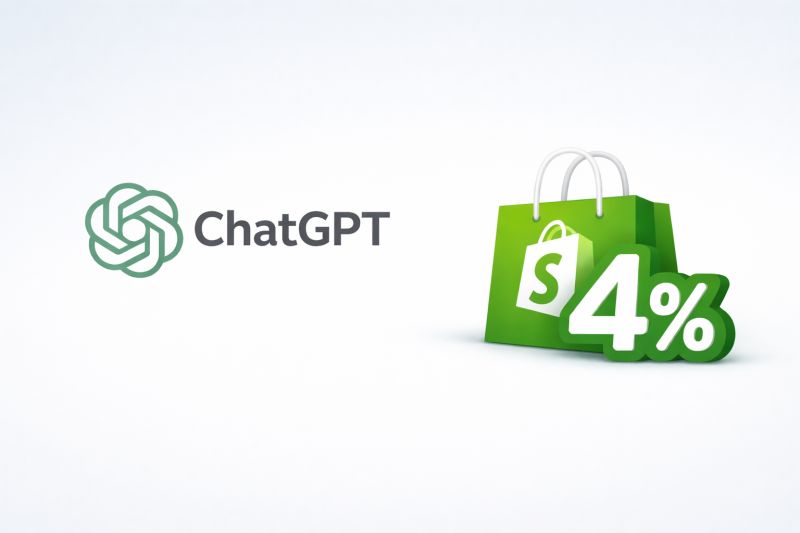
The first real signal is emerging, with ChatGPT reportedly testing a 4% transaction fee.
And if you’ve been in eCommerce long enough, you know exactly what comes next.
Because we’ve seen this movie before.
AI Discovery Will Follow the Same Path as Search
I remember the days when 80% of my eCommerce revenue came from Google organic search.
Back then, the idea of “paying to be discovered” felt optional. Over time, it became unavoidable. Google had to monetise search, and advertising revenue only grew from there.
AI search will follow the same path.
That 4% transaction fee is unlikely to be the end state. It’s the opening move.
Sponsored placements, preferred partners, paid ranking, and a broader range of pay-to-play options feel inevitable. The economics of distribution always end up being monetised.
The question isn’t if AI discovery becomes a paid channel.
The question is how quickly it becomes one.
The New Acquisition Cost Is Already Here
If AI becomes a meaningful driver of commerce, brands will inherit a new cost in the customer journey.
Not a marketing cost in the traditional sense, but a distribution cost. A “transaction toll” paid at the moment of purchase.
That matters because many brands are already under pressure from:
rising CPMs and CAC on Meta and TikTok
increasing return rates
shipping and fulfilment inflation
discounting pressure across the category
higher inventory risk and cash tied up in stock
Add a new AI transaction fee on top and you’re looking at further profit erosion.
A 4% fee may not sound huge, but for many DTC brands, it’s the difference between a healthy contribution margin and a break-even order.
And the bigger point is this: once a fee exists, it rarely stays static.
The Real Risk: Profit Gets Squeezed From Both Ends
Brands are already fighting for margin in two places:
Before purchase (acquisition costs)
After purchase (returns, fulfilment, customer service costs)
AI introduces a third squeeze point:
At the point of transaction (a toll on the sale itself)
This is why the smartest operators should be thinking now about how to grow margin to protect profit, rather than burying their heads in the sand and hoping AI discovery stays free forever.
If your margin isn’t improving, your profit is at risk, even if revenue grows.
Shopify’s Move: Compete for the Transaction Layer, Not the Storefront
At the same time, Shopify has recently shared its Agentic Plan.
Most of the coverage has focused on the Universal Commerce Protocol with Google. But there’s a bigger strategic shift happening underneath it all.
This is the part that hasn’t been talked about enough:
Any brand can now plug into Shopify Catalog, even if they’re not on Shopify.
Magento, BigCommerce, custom stacks. It doesn’t matter.
Set up your product data once, and Shopify can syndicate it to where AI discovery is happening:
ChatGPT
Microsoft Copilot
Google AI Mode
Gemini
Then checkout happens through Shopify’s infrastructure.
That’s a massive statement of intent.
Shopify has stopped competing for your storefront.
They’re competing for the transaction layer underneath every AI conversation.
What This Means for Commerce in the Next 12–24 Months
Here’s the shift brands need to understand:
1) Your platform choice will matter less than your product data quality
In a world of AI-driven discovery, the best product doesn’t win. The best product data wins.
Structured attributes. Clean variants. Correct sizing. Populated metafields. Accurate imagery. Strong titles. Clear taxonomy.
If AI can’t interpret your catalogue, it can’t recommend you.
2) Product data becomes a growth lever, not an admin task
Historically, product data has been treated as a backend chore.
In the AI era, it becomes front-end performance.
If your catalogue is incomplete, messy, or inconsistent, you will pay for it in the form of:
lower visibility
lower conversion
higher returns
weaker margin
3) Margin becomes your moat
If discovery becomes more paid, brands without margin headroom will struggle.
The brands that win will be the ones that can afford the new distribution costs because they’ve built margin strength into the business.
That can come from:
improving pricing power through perceived value
reducing discount dependency
tightening product mix
improving contribution margin by SKU
reducing inventory waste
improving forecasting accuracy
optimising returns and shipping costs
Because in the future, the brands that scale won’t just be the ones with the best creative.
They’ll be the ones with the best economics.
The ProfitPeak View: Don’t Wait for the Fee to Hit Your P&L
The time to respond isn’t when AI transaction fees show up in your monthly reporting.
The time to respond is now, while you still have control.
At ProfitPeak, we help brands understand their business at the level required to protect profit in a world where acquisition costs keep evolving.
That means connecting the dots between:
advertising performance
product-level revenue
margin and contribution profit
inventory and incoming stock
forecasting and demand signals
Because if you don’t know which products are driving profit, you can’t scale efficiently.
And if you can’t scale efficiently, you don’t have the margin buffer to absorb new costs like AI transaction fees.
The Bottom Line
AI discovery won’t stay free.
Shopify isn’t betting on storefronts anymore. It’s betting on owning the transaction layer under every AI-led purchase.
And brands are about to face a new kind of acquisition cost in the customer journey, one that will erode profit unless margin improves.
The winners won’t be the brands that ignore it.
They’ll be the brands that build stronger economics now, so they can keep scaling later.
Carla Penn-Kahn
CEO & Co-Founder
Carla spent over a decade building and successfully exiting several e-commerce brands, following an earlier career in corporate advisory and investment at Credit Suisse.